
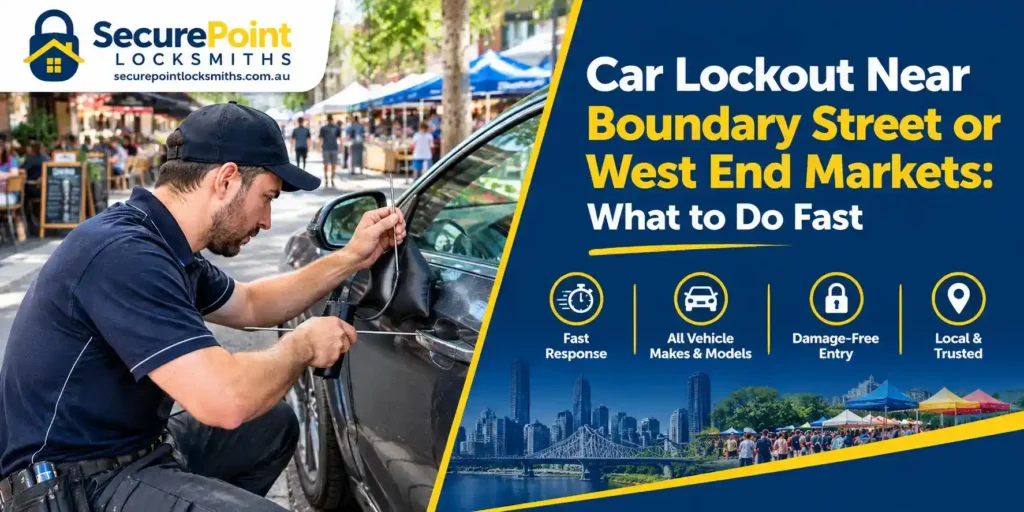
West End’s mix of busy commercial strips, market crowds, and tight inner-city parking means a car lockout here rarely happens somewhere quiet and convenient. It’s more likely to happen kerbside on Boundary Street during a lunch rush, in the multi-storey near the markets on a Saturday morning, or tucked into a narrow side street where you’ve squeezed into one of the last available spots. Car lockout West End drivers experience tends to come with its own set of practical complications tied directly to where these situations actually happen.
Locked Out on Boundary Street Itself
Boundary Street’s narrow lanes, constant foot traffic, and limited kerbside space mean a car lockout here creates an immediate secondary problem: your vehicle is likely sitting somewhere it can’t safely stay for long, whether that’s a loading zone, a metered space with a ticking clock, or simply blocking flow along one of West End’s busiest strips. The priority shifts slightly in this situation — getting back into the vehicle quickly matters not just for your own convenience but to avoid a parking infringement stacking on top of an already frustrating afternoon.
If you’re genuinely stuck in a spot causing an obstruction, it’s worth noting the exact location — which cross street you’re nearest, any identifying shopfront — when you call, since precise directions matter more on a strip this busy than they would in a quieter residential street.
Locked Out Near West End Markets
The markets bring their own particular version of this problem, mainly through sheer parking volume on market days. If you’ve locked your keys inside somewhere in the surrounding streets while browsing stalls, working out exactly where your car actually is can sometimes take longer than the lockout itself, especially if you parked further out than usual due to market-day congestion. Before calling a locksmith, it’s worth confirming your car’s exact location and street, since a locksmith arriving to the wrong end of a busy market precinct wastes time neither of you have.
Market days also mean nearby streets fill up with pedestrian traffic, which can make it harder for a locksmith to park close to your vehicle themselves. Mentioning that it’s a market day when you call gives them a heads-up to plan for this, rather than being caught out by restricted access once they arrive.
A Practical Habit for Market Regulars
If you’re a regular at West End Markets, taking a quick photo of your parking location — the street sign, a distinctive landmark — before you head off to browse removes the guesswork later if you do end up locked out. It’s a small habit that solves a surprisingly common source of delay.
Locked Out in a Residential Side Street
West End’s residential streets off the main strips often mean tighter, more informal parking than a marked commercial car park, sometimes without clear street numbering nearby to reference when giving directions. If you’re locked out here, having a nearby cross street or a specific landmark ready — a particular café, a distinctive building — helps a locksmith locate you quickly, since relying purely on “somewhere near the markets” or “somewhere on a side street off Boundary Street” can genuinely slow things down in an area with this much density.
What Actually Happens Once a Locksmith Arrives
Regardless of which specific West End location you’re locked out in, the actual entry process is consistent. A locksmith uses non-destructive tools designed specifically for vehicle entry, working through your door’s specific lock mechanism without any contact with paintwork or panels. Most straightforward car lockouts are resolved within fifteen to twenty minutes once the locksmith is actually on-site, with variation mainly coming from finding parking themselves in West End’s genuinely tight streets, rather than the lockout entry itself taking longer.
This is worth keeping in mind when estimating total wait time — the entry itself is quick, but a locksmith navigating West End’s parking to actually reach your vehicle can occasionally add a few extra minutes beyond what a suburb with easier street access would involve.
Reducing the Odds of It Happening Again
Car lockouts happen to careful, attentive drivers all the time — it’s rarely a sign of carelessness so much as a distracted moment, often made more likely in a busy area like West End where you’re juggling parking, pedestrian traffic, and errands simultaneously. A spare key kept somewhere accessible but not inside the vehicle itself — with a partner, at home, or in a bag rather than a pocket that might get emptied absentmindedly — genuinely reduces how often this scenario repeats.
For anyone parking in West End regularly for work or frequent visits, it’s also worth double-checking your car doesn’t have a habit of auto-locking after a short delay, a feature on some newer vehicles that can catch drivers out if they’ve stepped away briefly without realising the doors have already secured themselves.
Why West End’s Layout Makes This More Common Than Nearby Suburbs
Compared to some of Brisbane’s more spread-out inner suburbs, West End’s combination of dense foot traffic, mixed commercial and residential parking, and genuinely limited on-street space means drivers here are juggling more variables at once when parking and leaving their vehicle. Finding a spot itself often takes longer, which means more decisions happening in quick succession — where to park, how long the meter allows, whether to feed change into it, gathering everything you need for wherever you’re heading. Each additional step is another moment where keys can end up somewhere unexpected, whether that’s locked inside during a quick dash back to the car or left in a jacket pocket now sitting on the passenger seat.
This isn’t unique to West End by any means, but the suburb’s particular mix of market crowds, café culture, and tight commercial strips does mean the pattern shows up here with reasonable regularity, especially on weekends when both the markets and the broader Boundary Street precinct are at their busiest.
What to Do While You Wait
Once you’ve called and confirmed a locksmith is on the way, there are a few sensible things worth doing rather than simply standing beside the vehicle. If you’re in a loading zone or a spot with genuine time restrictions, it’s worth checking whether nearby signage gives any grace period or whether moving to stand somewhere visibly waiting — near the vehicle but out of the direct traffic flow — reduces the odds of a parking officer treating the situation as a straightforward infringement rather than an active lockout.
If valuables are visible inside the locked vehicle, it’s also worth staying nearby rather than wandering off to continue whatever errand you were originally running, simply as a sensible precaution in a busy public area until the locksmith arrives and the vehicle is properly secured again.
When the Lockout Involves More Than Just the Driver’s Door
Occasionally a lockout in West End’s busier areas involves more complexity than a simple locked door — a boot that won’t open remotely, for instance, or a situation where keys are visible but genuinely out of reach inside the vehicle. Mentioning any of these specifics when you call means the locksmith arrives with the right expectations and tools, rather than assuming a standard door-only lockout and needing to reassess once they’ve actually seen the situation.
Conclusion
Car lockout West End situations come with a genuinely different set of practical complications depending on exactly where they happen — a busy commercial strip, a crowded market precinct, or a tight residential side street all call for slightly different information when you make the call. Having your precise location ready, whether that’s a cross street, a landmark, or confirmation it’s market day, gets you back on the road faster than a vague description ever will.
West End’s density is part of what makes it such a lively place to park, shop, and live — it’s also exactly why a little extra precision when calling for help pays off more here than it might in a quieter, more spread-out suburb. A precise location, a mention of market-day crowds where relevant, and a brief note on any complicating factors are small details that add up to a noticeably faster resolution in a suburb this busy.