
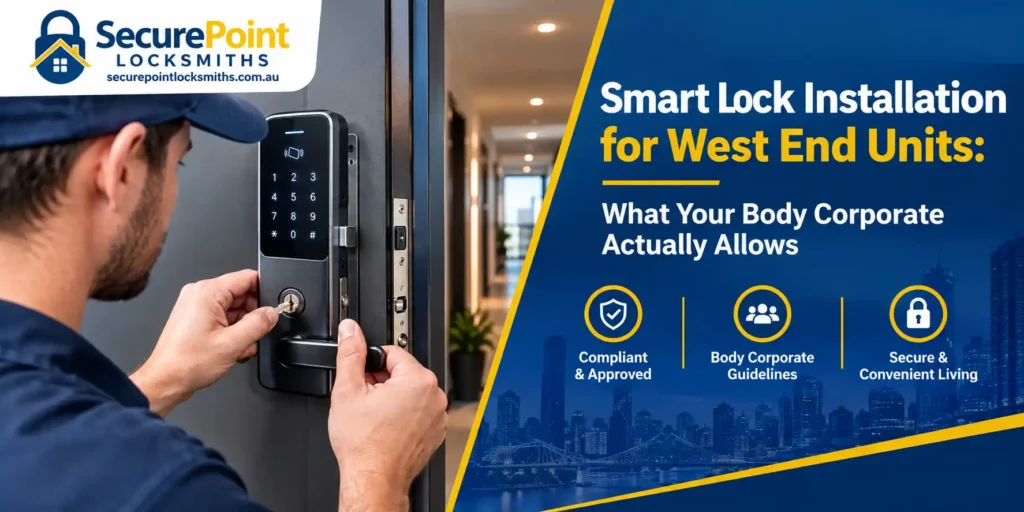
Smart lock installation units West End owners consider often stalls at the same point: enthusiasm about the convenience, followed by genuine uncertainty about whether the body corporate will actually permit it. Unlike a standalone house, where you can generally fit whatever lock you like to your own front door, a unit sits within a shared building governed by by-laws that may or may not have anything to say about door hardware. Working through the actual considerations, rather than guessing, saves both wasted purchases and awkward conversations after the fact.
Consideration One: What Counts as “Your” Door
The first thing worth understanding is where your unit’s boundary actually sits under most body corporate schemes. In many Queensland strata arrangements, the external face of your unit door — sometimes even the door itself — can be classified as common property, while only the internal side and the lock mechanism are considered part of your exclusive-use lot. This distinction matters enormously for smart lock installation, since altering something classified as common property typically requires body corporate approval, while modifications entirely within your own lot generally don’t.
This isn’t consistent across every West End building, though. Some by-laws are written more permissively, treating the entire door as part of the unit owner’s responsibility. Checking your specific building’s registered by-laws, or asking the body corporate manager directly, is a necessary first step before assuming either way.
Consideration Two: Whether the By-Laws Mention Locks Specifically
Some body corporate schemes include explicit clauses about door hardware, often as part of broader rules around external appearance or fire safety compliance. A smart lock that changes the visible appearance of a unit’s front door — a different colour, a different handle style, a keypad where there wasn’t one before — can sometimes fall under appearance by-laws even when the underlying mechanical change wouldn’t otherwise require approval.
Fire safety compliance is a separate and genuinely important consideration too. Some buildings have specific requirements around how quickly a door can be opened from inside during an emergency, and certain smart lock configurations — particularly ones that rely entirely on a code or app with no mechanical override — can create compliance issues if they slow down emergency egress. This is worth raising directly with your body corporate manager rather than assuming any smart lock on the market is automatically compliant.
A Practical Middle Ground
Choosing a smart lock that retains a standard mechanical key override alongside its electronic features tends to sidestep most fire safety concerns, since the door can still be opened the traditional way if needed. This is worth prioritising when comparing products, even beyond the body corporate question, simply as a sensible backup for situations where the smart lock’s battery or connectivity fails.
Consideration Three: The Approval Process Itself
If your building’s by-laws do require approval for changes to your door, the process is usually more straightforward than owners expect. Most body corporate schemes have a standard form for lot owners to submit proposed alterations, which then goes to either the committee or a general meeting depending on the scale of the change. A smart lock installation, being a relatively minor and easily reversible modification, rarely faces serious objection once properly submitted — the friction usually comes from owners skipping the process entirely rather than the request itself being controversial.
Submitting product details, including the make and model, alongside confirmation that a mechanical override exists, tends to smooth this process considerably. Committees are generally more comfortable approving something specific and well-documented than a vague request to “install a smart lock.”
Consideration Four: What Happens If You Skip Approval
Installing a smart lock without seeking required approval, where your by-laws do call for it, creates a genuine risk down the line. Body corporates can, and occasionally do, require unauthorised alterations to be reversed, which means potentially paying to remove a smart lock and reinstall standard hardware, on top of the original installation cost. This outcome is avoidable entirely by checking the requirement upfront rather than installing first and hoping nobody raises it.
It’s also worth considering resale and lease implications. An unauthorised alteration can complicate a future sale or new tenancy, since incoming buyers or renters — and their own due diligence processes — may flag hardware that doesn’t match what’s on record for the property.
Consideration Five: Rental Properties Add a Further Layer
For West End units that are tenanted rather than owner-occupied, there’s a second layer of permission sitting above the body corporate question: the landlord’s own consent. Even where a body corporate would approve a smart lock installation, a tenant generally still needs their landlord’s agreement before modifying the property’s locks at all, smart or otherwise. Raising both permissions together — landlord consent and body corporate approval — in a single conversation tends to be more efficient than tackling them separately.
What Locksmith Installers Can Help Clarify
An experienced locksmith working regularly across West End’s unit buildings has often seen a given building’s specific by-law approach before, or at least dealt with similar strata arrangements nearby. While a locksmith isn’t a substitute for checking your actual by-laws directly, this kind of practical, building-type familiarity can help set realistic expectations before you formally submit anything, and can guide you toward smart lock models more likely to sail through an approval process without complications.
A good installer will also flag technical considerations specific to unit living that owners don’t always think of upfront — whether the door’s existing hardware is compatible with a given smart lock’s mounting requirements, for instance, or whether the door’s fire rating (common in many multi-storey West End developments) limits which products can be legally fitted regardless of body corporate approval. Fire-rated doors in particular sometimes require specific certified hardware, and installing a non-compliant smart lock can create issues entirely separate from the strata approval process.
Weighing Up the Genuine Benefits Against the Process
It’s worth stepping back and considering why the approval process is worth navigating in the first place, rather than simply sticking with a traditional key. For unit owners who travel frequently, or who regularly host guests, tradespeople, or short-term visitors, a smart lock genuinely simplifies access management in a way that’s difficult to replicate with physical keys alone. Temporary codes that expire automatically, activity logs showing who entered and when, and the simple convenience of never needing a physical key at all are meaningful upgrades for the right household.
For owners who rarely need to share access and are primarily motivated by novelty rather than a genuine practical need, the approval process might reasonably feel like more effort than the benefit justifies. This is worth an honest assessment before committing time to body corporate paperwork — the process itself isn’t difficult, but it does take a small amount of genuine effort that’s only worthwhile if the underlying convenience actually matters to your specific situation.
A Realistic Timeline to Expect
For unit owners wondering how long this process typically takes, it varies depending on how your specific body corporate operates. Buildings with an active committee that meets regularly can sometimes approve a straightforward alteration request within a few weeks.
Buildings that only formally vote on such matters at scheduled general meetings might mean waiting considerably longer, particularly if your request happens to fall just after a meeting has already occurred. Asking your body corporate manager directly about typical turnaround times for alteration requests gives a much more accurate picture than assuming a generic timeframe. Building this timeline into your planning is particularly worth doing if you’re hoping to have a smart lock installed before a specific date, such as an upcoming period of travel or a planned change to how the unit is used.
Conclusion
Smart lock installation units West End owners are considering genuinely can work well within a body corporate structure — the key is approaching it methodically rather than assuming either blanket permission or blanket prohibition. Understanding where your door sits under the by-laws, whether appearance or fire safety clauses apply, and following the proper approval process where required turns a potentially awkward situation into a straightforward, well-documented request.
For unit owners genuinely interested in the convenience a smart lock offers, a small amount of upfront diligence with the body corporate saves considerably more hassle than installing first and dealing with objections later. It’s a worthwhile investment of time for hardware you’ll likely be using every single day.