
Three renters, three West End units, three very different move-in experiences. The details below are composites drawn from the kind of calls we get regularly, but the pattern behind them is real, and it’s one that plays out across West End’s large rental market more often than most tenants realise.
The Tenant Who Assumed New Keys Meant New Security
A young professional signs a twelve-month lease on a unit near West End Markets, collects two sets of keys from the agent at the handover inspection, and assumes that’s the end of the security question. What she doesn’t know is that the unit had three previous tenants over the past five years, a regular cleaner who visited fortnightly during at least one of those tenancies, and a maintenance contractor who was given a key during a bathroom renovation two tenants ago.
None of those people necessarily still have a working copy. But nobody can say for certain they don’t, either — and that uncertainty is exactly the gap rekeying closes. Asking about rekeying rental locks West End landlords manage isn’t an accusation that anyone’s done anything wrong; it’s simply acknowledging that rental properties accumulate key history in a way owner-occupied homes generally don’t.
What Actually Happens During a Rekey
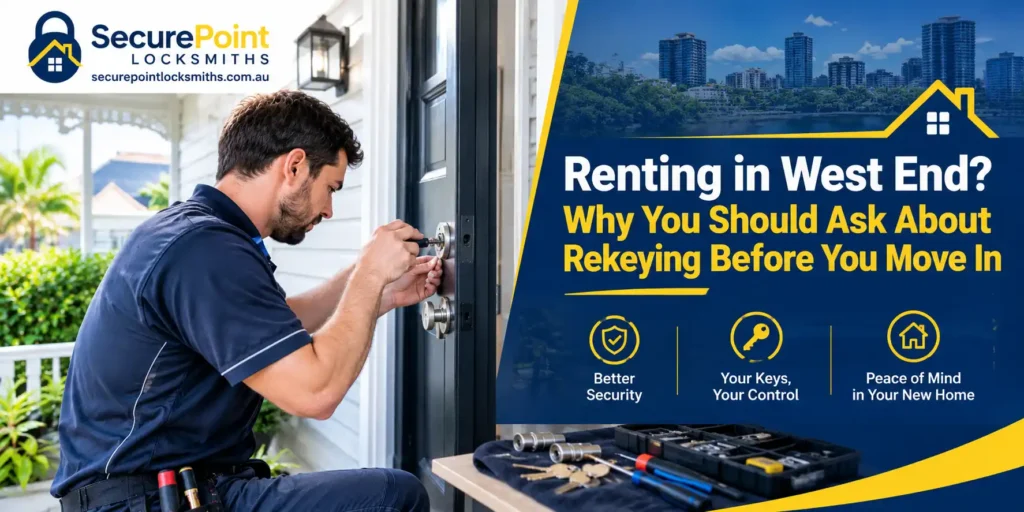
Rekeying replaces the internal pin configuration inside the existing lock cylinder, so every previous key stops working the moment the job is complete. It doesn’t require new hardware, doesn’t change how the lock looks, and can usually be completed in under half an hour per door. For a landlord weighing this up, it’s a considerably smaller undertaking than a full lock replacement, which makes it a genuinely reasonable request to raise during lease negotiations rather than something that feels like an imposition.
The Tenant Who Waited Until Something Felt Wrong
A share-house arrangement near Boundary Street goes through a tenant change — one housemate moves out, a new one moves in, and everyone assumes the departing housemate has handed back their key. Six months later, small things start feeling slightly off: furniture moved a few centimetres, a light left on that nobody remembers leaving on. Nothing dramatic, nothing that would hold up as evidence of anything, just a nagging sense that doesn’t sit right.
In this scenario, rekeying isn’t really about proving anything happened — it’s about removing a specific, nameable possibility from the list of things that could explain it. Waiting for a concrete reason before rekeying means living with that background uncertainty for months longer than necessary, when the fix itself takes less time than most other move-related admin.
A Note on Shared Housing Specifically
West End’s rental market includes a genuinely high proportion of share housing, given its proximity to the CBD and the university precincts nearby. Every departure from a shared house is worth treating as a natural rekeying trigger, not just the initial move-in. It’s a habit worth establishing with housemates from the start, so it doesn’t feel like a big conversation each time someone new moves through.
The Tenant Who Simply Asked Upfront
A couple inspecting a renovated Queenslander conversion in West End, split into two separate units, raises the rekeying question directly with the property manager during the lease signing appointment. The property manager confirms it’s standard practice between tenancies for this particular landlord, and the couple move in with genuine confidence that the keys handed over are the only working set in circulation.
This is, realistically, the outcome every renter is hoping for, and it’s achievable simply by asking the question rather than assuming either way. Some landlords already rekey as a matter of course; others have simply never been asked and are happy to arrange it once a tenant raises it directly.
How to Actually Raise It
The most straightforward approach is asking directly during lease negotiations, before signing: “Has this property been rekeyed since the last tenancy, and if not, would you be open to arranging it?” Framing it as a practical, reasonable request — rather than an accusation or a demand — tends to get a far more cooperative response, and most landlords managing rental security responsibly will already understand why the question matters.
What If the Landlord Says No?
Not every landlord will agree to rekey between tenancies, whether due to cost, time, or simply not having considered it a priority before. In these situations, a tenant genuinely concerned about the gap can sometimes arrange and cover a rekey themselves, provided the landlord consents to the work being done — though this obviously shifts the cost onto the tenant rather than the property owner.
It’s worth checking your specific tenancy agreement and understanding what modifications to locks are permitted under it before arranging anything independently, since unauthorised changes to a rental property’s locks can create their own complications separate from the original security concern.
There’s a middle-ground option worth knowing about too: some tenants, when a full rekey isn’t agreed to, opt to add a supplementary lock to their bedroom door instead, provided this is permitted under the lease. It doesn’t address the main entry point, but for share housing arrangements specifically, it offers a layer of personal security that doesn’t require the landlord’s cooperation on the property’s external locks at all.
Questions Worth Asking at the Property Inspection
Beyond the direct rekeying question, a handful of related points are worth raising during the initial inspection, before you’ve committed to a lease. Asking how many previous tenants have occupied the property recently gives a rough sense of key turnover, even if the property manager can’t give an exact number of copies in circulation. Asking whether the locks themselves look original to the building or have been updated at some point can also be a useful indicator, since older, unchanged hardware on a heavily rented property is a reasonable prompt to raise the rekeying question more firmly.
It’s also worth asking directly who currently holds keys to the property — the agency, the landlord personally, a cleaning service, a maintenance contractor — since this gives you a clearer picture of the realistic access landscape beyond just previous tenants. None of these questions are unusual or overly demanding for a rental inspection; they’re the kind of practical due diligence that a reasonable landlord or property manager should expect from a prospective tenant.
What This Costs a Landlord, Realistically
From a landlord’s perspective, rekeying between tenancies is a relatively minor expense compared to the broader costs of managing a rental property, and it’s considerably cheaper than a full lock replacement across every external door. Framing the request this way — as a modest, practical step rather than a significant financial ask — often helps when raising it with a landlord or agent who hasn’t previously considered it standard practice. Many property managers, once the request is made clearly, simply add it to their standard between-tenancy checklist going forward, which benefits every future tenant of that property as well.
Why This Matters More in a High-Turnover Market
West End’s rental turnover tends to run higher than many surrounding suburbs, given its popularity with students, young professionals, and share-house arrangements that naturally shift more often than family-occupied rentals. Each tenancy change is another point where keys can go uncollected, unreturned, or simply forgotten about in the chaos of moving. Over several years and several tenancies, the realistic number of active key copies for a single rental property can end up considerably higher than most incoming tenants would guess.
This isn’t a reason to feel anxious about renting in West End specifically — it’s simply the practical reality of a high-turnover rental market, and it’s exactly why raising the rekeying question upfront is worth the brief, slightly awkward conversation it might involve. The alternative, staying quiet and hoping for the best, trades a few seconds of minor awkwardness for months or years of unresolved uncertainty about who else might still hold a key.
Conclusion
Rekeying rental locks West End tenants move into isn’t automatic, and it’s not something every landlord thinks to arrange without being asked. The three scenarios above all end differently depending on one simple factor: whether the question got raised early, waited on, or asked directly upfront.
For anyone about to sign a lease in West End, adding one direct question to the move-in conversation — has this property been rekeyed since the last tenant — costs nothing and takes a few seconds, but it closes a genuine security gap that otherwise sits quietly in the background of a new tenancy for as long as nobody thinks to address it.