
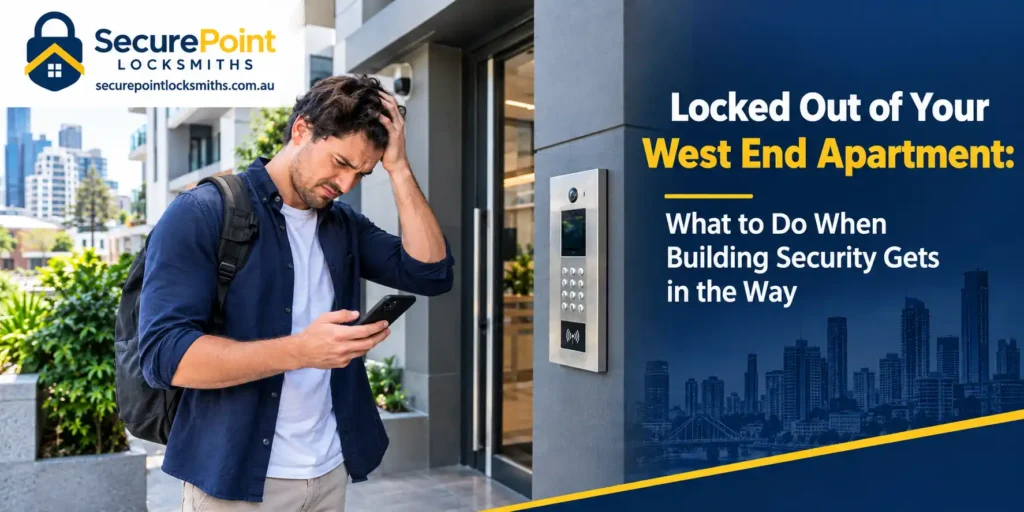
It’s a scenario that plays out differently in West End than almost anywhere else in Brisbane. You’re not just locked out of your own front door — you’re locked out of a building with a fob-controlled entrance, an intercom system that might or might not connect to anyone useful, and possibly a property manager who’s already gone home for the day. Locked out of apartment West End residents deal with regularly involves layers a standalone house simply doesn’t have, and that changes what actually works to get you back inside.
This guide walks through exactly how to approach an apartment lockout in West End, step by step, rather than the generic advice that assumes you’re dealing with a single front door and nothing else.
Step One: Work Out Which Lock You’re Actually Locked Out Of
Before calling anyone, figure out exactly where the problem sits. Are you locked out of the building itself, unable to get past the ground-floor entrance? Or are you inside the building but locked out of your own unit door? These are genuinely different problems with different solutions, and mixing them up wastes time on a lockout call that ends up needing a second, entirely different type of assistance.
If it’s the building entrance, check whether there’s a visitor intercom that connects to other residents — someone buzzing you in solves the problem instantly, at zero cost and zero wait. If it’s your own unit door once you’re already inside the building, this is a more standard residential lockout, just one that happens to be on the third floor rather than at street level.
Step Two: Check If Building Management Can Help Before Calling a Locksmith
Many West End apartment buildings, particularly the larger developments along Vulture Street and closer to the river, have an on-site or contactable building manager who holds master keys or fob access. This is worth checking first, since it can resolve the entire situation without needing an external callout at all. Even outside business hours, some buildings have an after-hours contact number posted near the mailboxes or intercom panel specifically for this kind of situation.
If building management genuinely isn’t available or doesn’t hold access to individual unit doors — which is common, since many managers can get you into the building but not your specific apartment — this is exactly when a locksmith becomes necessary rather than optional.
Local Insight:
Save your building’s after-hours contact number in your phone now, before you actually need it — searching for it while locked out wastes valuable time.
Step Three: Understand What a Locksmith Can and Can’t Bypass
A locksmith can open your actual unit door using standard non-destructive techniques, the same way they would for any house lockout. What a locksmith generally can’t do is bypass an electronic building fob system or a coded intercom entry — that access sits with building management or the strata scheme, not with individual lock hardware. Knowing this upfront prevents a frustrating situation where you’ve called a locksmith who arrives ready to open your unit door, only to discover you’re both still stuck outside the building itself.
Being upfront with the locksmith about your exact situation when you call — that you’re in a West End apartment building, whether you’re locked out of the building or just your unit — means they arrive prepared for the actual job rather than a generic house call.
Step Four: Have Identification Ready for a Multi-Unit Building
Verification matters even more in an apartment context than a standalone house, since a locksmith opening a unit door in a shared building needs to be confident they’re helping the actual resident rather than anyone who happens to be standing in the hallway. Having your driver’s licence, a lease agreement, or mail addressed to your specific unit number ready speeds this process along considerably.
If you’re a tenant rather than an owner-occupier, it’s also worth having your property manager’s contact details on hand, since some locksmiths prefer a quick confirmation call for unit lockouts specifically, given the shared-building context.
Step Five: Think About Prevention for Next Time
Apartment lockouts in West End tend to repeat themselves more than house lockouts do, largely because there are more access points to manage — a building fob, a unit key, sometimes a separate mailbox key, and occasionally a car park remote as well. Losing track of any single one of these can trigger the whole scenario again.
A spare unit key held by a trusted neighbour in the same building solves the unit-door half of the problem for future incidents, since they’re already inside the building and can let you in without needing building management or a locksmith at all. For the building-access half, checking whether your building offers a backup entry method — a keypad code alongside the fob system, for instance — is worth asking your body corporate about directly.
It’s also worth reviewing how many separate items you’re actually carrying for building access. Some residents consolidate everything onto a single keyring — unit key, fob, mailbox key — which is convenient day to day but means one lost keyring locks you out of everything simultaneously. Splitting the fob onto a separate keyring, or keeping a spare fob at work or with a partner, reduces the odds of a total lockout even if you do misplace your main set of keys.
Why Older West End Buildings Sometimes Complicate Things Further
West End’s mix of newer high-rise developments and older, smaller walk-up apartment blocks means the lockout experience isn’t identical across the suburb. Older buildings, particularly some of the smaller blocks tucked behind the main streets, sometimes still rely on traditional keyed building entrances rather than electronic fobs, with no after-hours management contact at all. In these buildings, a locksmith can often help with both the building entrance and the unit door in the same visit, since there’s no electronic system standing in the way — just standard mechanical locks throughout.
Newer developments, by contrast, tend to have more sophisticated but also more restrictive access systems. A lost fob in one of these buildings genuinely can mean waiting for a business-hours reissue from the body corporate, since the electronic system itself isn’t something a locksmith’s tools are designed to bypass. Knowing which category your building falls into shapes realistic expectations for how quickly a lockout can actually be resolved.
What This Looks Like in Practice
Picture a fairly typical version of this scenario: you’ve stepped down to grab a coffee from one of the cafes near West End Markets, and the unit door has swung shut behind you without your keys. If you’re still inside the building, this is a straightforward unit lockout — a locksmith can reach the building and open your specific door without needing to deal with the building’s entry system at all. If you’ve left the building entirely and your fob was on the same set as your unit key, you’re now dealing with both problems at once, and the priority becomes getting back through building security first.
Understanding which version of the problem you’re actually facing, before you make any calls, is what separates a quick fifteen-minute resolution from an hour of confusion between building management, a locksmith, and a property manager all pointing you toward each other.
There’s a similar version of this scenario worth mentioning too — arriving home late from work along Montague Road only to realise your unit key is missing entirely, not just left inside. In this case, the building fob still works, so you’re not locked out of the building, but you’re facing a genuine lockout at your own door with no quick internal fix available. This is where a straightforward locksmith callout, focused purely on the unit door, resolves things cleanly without any building-access complications at all.
Conclusion
Locked out of apartment West End situations genuinely differ from a standard house lockout, mainly because there’s an extra layer of building security sitting between you and your own front door. Working out exactly which lock or access system is actually the problem — building entrance, unit door, or both — before calling anyone means whoever you do call arrives ready for the job you actually have.
Whether it’s building management, a locksmith, or both working together, West End’s apartment-heavy layout means lockouts here call for a slightly different approach than the advice written for standalone homes. Knowing that difference in advance is genuinely half the battle.